American Realities with Bill Youngs
  • Home Page
  • About Me
    • Brief Résumé
    • Illustrative Films
  • Summary
  • Workshop
    • Jobs for Historians
    • Maps
    • Slideshows
  • Images
    • A Walk Through Turnbull
  • Fireside Talks
    • American History >
      • Indigenous Alaska: The Baidarka
    • National Parks
  • Spoken Word
  • Books
    • Gods Messengers: Religious Leadership in Colonial New England, 1700-1750 >
      • Table of Contents
      • Preface
      • Chapter 1: The Ministers and Their Times
      • Chapter 2: The Minister's Calling
      • Epilogue
      • Appendix: Length of Ministerial Settlement
      • Abbreviations
    • The Congregationalists >
      • Timeline
      • Bibliographic Dictionary of Leaders
    • Eleanor Roosevelt: A Personal and Public Life >
      • Prologue: The South Pacific, 1943 >
        • Eleanor Roosevelt South Pacific
      • A Victorian Family
      • The Legacy
      • Growing Up
      • Eleanor and Franklin
      • A Politician's Wife
      • Grief
      • Public Service
      • First Lady
      • The Democratic Crusade
      • On Her Own
    • American Realities (Book) >
      • History as a Story
      • A Note on Wikipedia as a Source
      • Volume One >
        • The Native Americans
        • The English Background
        • The British American
        • Reform in Colonial America
        • Divided Loyalties
        • The American Revolution
        • Testing the Constitution
        • Republican Nationalism
        • The Limits of Jacksonian Democracy
        • Abolitionists and Anti-abolitionists
        • Texas Revolution
        • Reform in the Early Republic
        • Manifest Destiny
        • A Slave's Story
        • The Civil War >
          • Two Soldiers
      • Volume Two >
        • The “Taming” of the West
        • Beyond Emancipation
        • The New Industrial Era
        • The Birth of Environmentalism
        • New Immigrants
        • Expanding American Democracy
        • World War I
        • Modernity versus Tradition
        • The New Deal
        • Total War
        • The Cold War
        • The Civil Rights Movement
        • Turmoil on the Campuses
        • The New Computer Age
        • America, the Cold War, and Beyond
      • Additional Essays >
        • Norsemen in the New World
    • The Fair and the Falls >
      • Part I: Possessing the Falls >
        • Chapter One: James Glover: Purchasing the Falls
        • Chapter Two: Waiting for the Indians
        • Chapter Three: Harnessing the Falls
        • Chapter Four: "The World's Fair of the Northwest"
        • Chapter Five: The City Beside the Falls
      • Part II: Rediscovering the Falls >
        • Chapter Six: The Twilight of Old Spokane
        • Chapter Seven: Urban Blight and Urban Renewal
        • Chapter Eight: King Cole and The Heart of a City
        • Chapter Nine: Visualizing a World's Fair
      • Part III Redesigning the Falls >
        • Chapter Ten: From Spokane to Paris >
          • Tom Foley's Turn
        • Chapter Eleven: Wooing the Foreign Exhibitors
        • Chapter Twelve: Wooing the Domestic Exhibitors
        • Chapter Thirteen: The Environmental Debate
        • Chapter Fourteen: Building the Fair
        • Chapter Fifteen: Marketing, Money, and Management
      • Part IV: The Fair by the Falls >
        • Chapter Sixteen: Opening Day
        • Chapter Seventeen: A Mingling of Peoples
        • Chapter Eighteen: Days at the Fair
        • Chapter Nineteen: The Press of New Ideas
        • Chapter Twenty: The Final Tally
      • Part V: An American Environment >
        • Chapter Twenty-One: Spokane Falls, An American Environment
      • The Fair and the Falls Map
J. William T. "Bill" Youngs, The Fair and the Falls: Spokane’s Expo ’74: Transforming an American Environment, Chapter Three   
                                             "Spokane Falls" courtesy of the Washington State Archives

Chapter Three: Harnessing the Falls 

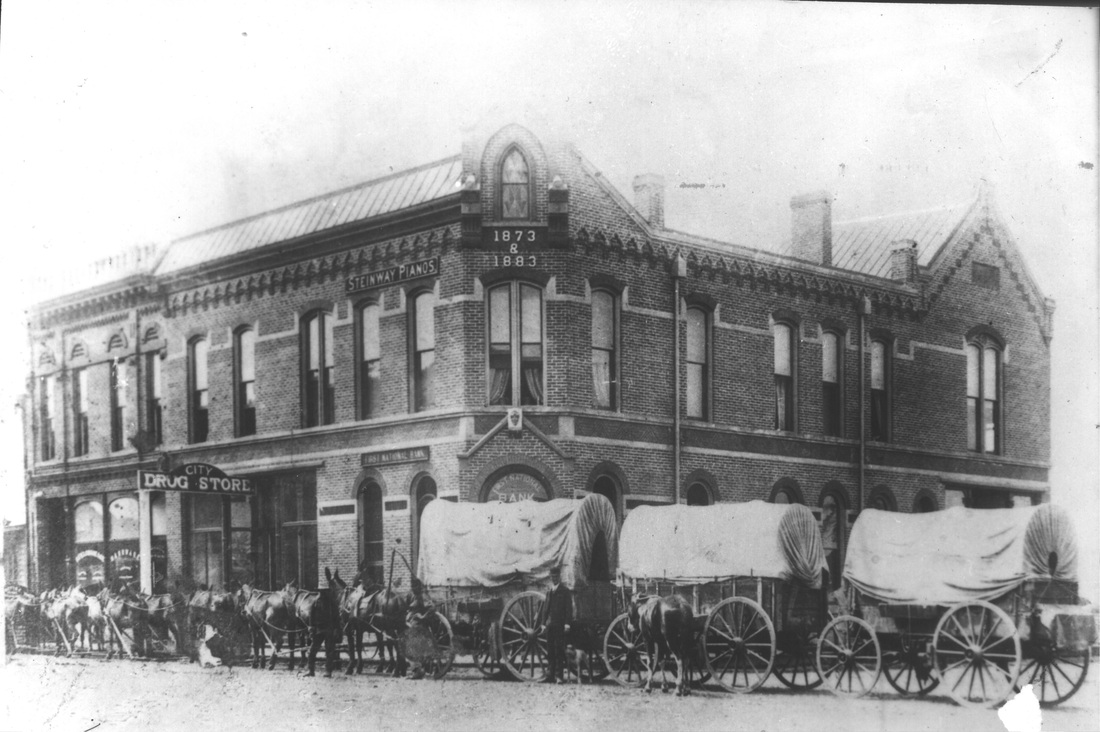
Picture
Wagon Train at corner of Howard Street & Front Avenue (Spokane Falls Blvd)

Summary

Although Spokane's initial growth was slow, with the arrival of the railroads its population and industry expanded rapidly. The falls, once prized for their beauty, were put to work powering mills and electric plants. Spokanites took pride in the development of their city and fought neighboring Cheney to claim the county seat. Even periodic floods and the devastating fire of 1889 could not repress their determination to make theirs the preeminent city of the booming West.

Author reads from the Text

"Virgin grandeur"

Carrie Strahorn, who visited the Northwest in 1880, wrote: "The virgin grandeur and beauty of the Spokane country appealed to us as no other place had done in all our travels. The little village of four hundred or five hundred people straggling over the park-like openings among the pines impressed us as one of the most picturesque in America."

"A new world"

"On the Spokane River bank in 1880, you would have seen a sight the Indians had known long before James Glover came to Spokane. Return to the same spot just ten years later, and you would see a new world. Bridges spanned the river and connected islets to the shore. Union Pacific tracks ran right beside the falls. Flumes pushed into the current, diverting the water into flour mills, sawmills, and hydro-electric plants. Trees were cut back to make way for buildings. Fill dirt had eliminated at least one of the river channels. Piles of lumber lay along the shore, and the floor of one sawmill extended from the south bank of the river to Havermale Island, hiding the southern-most channel."

"Natural wonder"

"With factories growing up beside Spokane's falls, the river seemed to be reduced to human proportions. But occasionally an accident or a flood reminded Spokanites of the primitive power of their falls....The citizens continued to view the floods with mixed emotions. Their practical natures told them the falls were there to be harnessed, but they were still drawn to the river as a thing of beauty. Like James Glover a few years before, urban Spokanites were committed to making the falls useful, but they were still fascinated by the natural wonder in their midst."


Chapter Two: Waiting for the Indians
Home
Chapter Four: "The World's Fair of the Northwest"